reading-notes
Class 15 - Trees, Job Search Workshop
Lab 15 - None
Setup
Code Challenge
- Branch Name: trees
- Challenge Type: New Implementation
Feature Tasks
- Node
- Create a Node class that has properties for the value stored in the node, the left child node, and the right child node.
- Binary Tree
- Create a Binary Tree class
- Define a method for each of the depth first traversals:
- pre order
- in order
- post order
- Each depth first traversal method should return an array of values, ordered appropriately.
- Binary Search Tree
- Create a Binary Search Tree class
- This class should be a sub-class (or your language’s equivalent) of the Binary Tree Class, with the following additional methods:
- Add
- Arguments: value
- Return: nothing
- Adds a new node with that value in the correct location in the binary search tree.
- Contains
- Argument: value
- Returns: boolean indicating whether or not the value is in the tree at least once.
- Add
Written Class Notes
Read 15 - Tree Implementation
Resources Link/Pages
Answer
To turn in your reading “Reply” to this discussion by teaching something that you learned. Then review what one of your classmates learned, and leave a comment.
Some ideas for how you might want to teach:
- Use an analogy
- Explain a detail in depth
- Use WHY, WHAT, HOW structure
- Tutorial / walk through an example
- Write a quiz
- Create a vocabulary/definition list
- Write a cheat sheet
- Create a diagram / visualization / cartoon of a topic
- Anthropomorphize the concepts, and write a conversation between them
- Build a map of the information
- Construct a fill-in-the-blank worksheet for the topic
Vocabulary/Definition List for Linked Lists
-
Trees:
- Definition: A hierarchical data structure composed of nodes, where each node has a value and references to other nodes.
- Analogy: Think of a family tree where each person is a node, and relationships (edges) connect parents to children.
- Node: A component in a tree containing values and references.
- Root: The starting node of the tree.
- K - A number that specifies the maximum number of children any node may have in a k-ary tree. In a binary tree,
k = 2. - Left - A reference to one child node, in a binary tree
- Right - A reference to the other child node, in a binary tree
- Leaf: A node without any children.
- Edge: The link between a parent and child node.
-
Height: The number of edges from the root to the furthest leaf.
-
Traversals:
- Definition: The process of visiting nodes in a specific order.
- Analogy: Navigating through a library by either exploring shelves from left to right (Breadth First) or going deep into each aisle (Depth First).
-
Depth First:
- Definition: Traversal prioritizing the depth (height) of the tree first.
- Analogy: Exploring a maze by choosing paths that go deeper before exploring other branches.
-
Breadth First:
- Definition: Traversal iterating through each level of the tree.
- Analogy: Searching a building floor by floor, covering all rooms on one level before moving to the next.
-
Binary Tree Vs K-ary Trees:
- Definition: Binary Tree restricts nodes to have at most two children, while K-ary Trees allow more than two.
- Analogy: Binary is like a road intersection with only left and right turns, while K-ary is like an intersection allowing multiple directions.
-
Binary Search Trees:
- Definition: A type of tree where values smaller than the root go left, and larger go right.
- Analogy: Organizing a bookshelf where books with titles starting with A-L are on the left and M-Z are on the right.
- Searching a BST:
- Definition: Locating a specific value in a Binary Search Tree.
- Analogy: Finding a word in a well-organized dictionary by comparing and narrowing down sections.
Learning Journal
Reflection
Take 10-15 minutes at the end of lab to respond to the following questions, adapted from the article:
- What went well, that I might forget if I don’t write down?
- I liked learning the career stuff today, but I forgot to write most of it down so will rewatch recording later to take notes again.
- What did I learn today?
- No matter the skills you have most of your chances of getting hired is through networking, which I don’t know how to do well so that’s going to be such a challenge.
- What should I do differently next time?
- Take screenshots of the slides.
- What still puzzles me, or what do I need to learn more about?
- I’m not understanding trees like I did stacks and queues so I will look at it more.
- Thinking about each of your assignments for the day, reflect on:
- Is the assignment complete? If not, where exactly did you leave off, and what work remains?
- Assignments are complete. Will work on readings for next week.
- Is the assignment complete? If not, where exactly did you leave off, and what work remains?
Career 15 - Partner Power Hour - Report #3
If there is no live presentation on campus in this module, select the appropriate presentation from the list below. All presenters are open to connections and invite you to reach out to them, so that you can to learn more about them, their company, and the industry. You may find it difficult or challenging to connect with industry professionals and gain an inside look at how the tech world operates. We’ve drawn on our network to bring you speakers and topics relevant to this stage of your career transition. These presentations may serve to educate, enlighten, and motivate you along your journey. Take advantage of this opportunity, and make the most of the insights these presentations provide… you never know where a connection will lead.
- Breaking Down the Tech Interview w/Rover - Rover Engineering Team
- Whiteboarding Tips & Strategies - Roger Huba
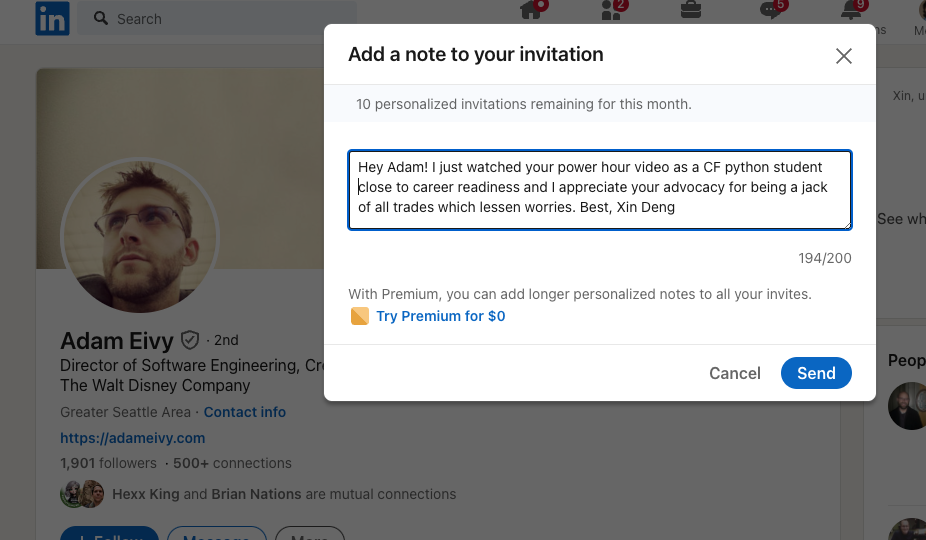
- Automate Yourself Out of a Job - Adam Eivy
- Communication Under Stress - Eve Denison
- Deep dive - Dev Tools - David Souther
- CI/CD History Lesson - Kat Cosgrove
- The 7 C’s of Cybersecurity & Coding - Courtney Hans
- Your Net Worth - John Cokos
Automate Yourself Out of a Job - Adam Eivy
-
Share one or two ways the speaker’s information will change your approach to your career transition.
- Advocates for being a “Jack of All Trades” in tech.
- Highlights the value of having a broad skill set for a holistic understanding.
- Encourages examining past code for continuous improvement.
- Demonstrating growth and adaptability through self-reflection.
-
List a few key take-aways from this presentation.
-
Automation Principles:
- Prioritizes automating daily tasks for efficiency.
- Advocates for integrating automation into the routine.
-
Customization Benefits:
- Stresses the importance of tailoring automation tools.
- Customization enhances effectiveness by aligning with individual preferences.
-
User-Centric Approach:
- Promotes learning from user experiences and feedback.
- Encourages iterative improvement based on real-world interactions.
-
Startup Strategies for Success:
- Highlights the significance of early product-market fit tests.
- Emphasizes direct engagement with end-users for authentic feedback.
-
Customer-Driven Automation:
- Suggests building automation based on personal needs.
- Recommends continuous testing with a genuine customer to ensure relevance.
-
Insights from User Interactions:
- Warns against working in isolation without user input.
- Encourages understanding user nuances for effective product development.
-
Versatility as a Strength:
- Advocates for being a “Jack of All Trades” in tech.
- Highlights the value of having a broad skill set for a holistic understanding.
-
Strategies for Career Growth:
- Recommends learning from on-the-job experiences.
- Identifying and addressing inefficiencies within the team contributes to growth.
-
Networking and Marketability Tactics:
- Emphasizes engagement with recruiters and industry professionals.
- Building an online portfolio, especially on GitHub, for showcasing skills.
-
Reflective Learning:
- Encourages examining past code for continuous improvement.
- Demonstrating growth and adaptability through self-reflection.
-
-
Share a screenshot of your LinkedIn connection request, including a nicely worded note, sent to the speaker or someone else at their company.
Career 15 - Workshop #3: Job Searches, Networking, and Negotiations
My scrambled notes
linkedin search : Javascript AND (web OR application OR software OR full* OR front* OR back) AND (develop OR programm* OR eng*)
creative circle, karat
linedin job search
- create 2 -3 saved searches
- only 1 search shoid filter expereince level
- entry level, associate, intern
- aply to all aplplicable jobs in the 2-7 and 8-15 range for each search
- everyday run each search and filter by posted today
-
Offer and Negotiations?
- A: Research and know the market
- B: Be confident because you have the skills. Documentation, teamwork, leadership, projects.
- C: Always try to negotiate. They expect it, draw attention to why you applied.
-
Targeted job search?
- A: Customize application materials. Customize your resume, cover letter, and portfolio for each application, highlighting relevant experiences and skills that match the specific job requirements.
- B: Connect with professionals in your industry through platforms like LinkedIn. Engage in conversations, seek advice, and inquire about potential job opportunities. Networking can open doors that traditional job searches might not.
- C: Make multiple points of contact within the company, dont worry about if they have job postings live, subscribe to newsletters blogs news alert
-
Networking?
- A: Sadly, most jobs are filled before they are posted. They are mostly filled internally
- B: Start before you need it. Start with existing base
- C: Questions to ask in coffee interviews: What does a junior do? I’m entering this workforce and i have no idea what to expect so what does the hiring process looks like, what problems are you solving, what’s the tech stack, what do code reviews look like, who does them
add contact as underscore first name last name company they are from eddit and track interactions
10-15 companies of interst vission and mission product clients marketing linkedin job listing not needed
- understand what linkedin page is telling you, loko at 10-15 emplotess to see what they are doing
cover letter; follow directions, customize for position, languages frameworks, tools, no more than 3 para - reserach and thinl through what you can build make suggest for the company offer a detailed feature suggestion find and describe a bug in their product or websitre
make multiple points of contact within the company
dont worry about if they have job postings live
write and review cover letters subscribe to newsletters blogs news alert
gpt here is my resume here is this job posting customzie my resume to it help me write two para cover leter for this job that highlights my…
network tips
most jobs are filled before they are posted jobs filled internally 85 percent of jobs come from neetworking
what networking is not not selling not collecting business cards
how do i network at events start before you need it start with existing base
questions to ask during coffee interviews whats the tech stack code reviews? what does a junior do im entering this workforce and i have no idea what to expect what hiring process looks like what problems are you solving
offer
research and know the market do you know CF grad average what do you think is market rate
offer dependent on where the HQ of the job is
-
Add contact as underscore first name last name company they are from
- Edit and track interactions
-
10-15 Companies of Interest
- Vision and mission
- Product
- Clients
- Marketing (LinkedIn and job listings not needed)
- Understand what LinkedIn page is telling you; look at 10-15 employees to see what they are doing
-
Cover Letter
- Follow directions, customize for position, languages, frameworks, tools (no more than 3 paragraphs)
- Research and think through what you can build; make suggestions for the company
- Offer a detailed feature suggestion
- Find and describe a bug in their product or website
- Make multiple points of contact within the company
- Don’t worry about if they have job postings live
- Write and review cover letters
- Subscribe to newsletters, blogs, and news alerts
- Follow directions, customize for position, languages, frameworks, tools (no more than 3 paragraphs)
-
GPT
- Share resume
- Customize resume for a specific job posting
- Help write a two-paragraph cover letter for a job, highlighting relevant skills
-
Networking Tips
- Most jobs are filled before they are posted
- Jobs filled internally
- 85 percent of jobs come from networking
- What networking is not: not selling, not collecting business cards
-
How to Network at Events
- Start before you need it
- Start with an existing base
-
Questions to Ask During Coffee Interviews
- What’s the tech stack?
- Code reviews?
- What does a junior do?
- I’m entering this workforce and have no idea what to expect.
- What does the hiring process look like?
- What problems are you solving?
-
Job Offer
- Research and know the market
- Know the Computer Science graduate average
- What do you think is the market rate?
- Offer dependent on where the HQ of the job is
sdet software development and test
QA quality assurance - software
learn wordpress php language content producing jobs (hey this is our content add a page or something)
technical writer
certified in agile
linked list, stack, tree , dictionaries
- I noticed you have a lot of internships under your belt. How did you get those opportunities? I was under the impression that internships were for people still in school.
- How did your internship experiences at Google and Instagram shape your career path?
- You also worked mostly on iOS/Android development. Can I ask why you went down that specialty?
- Follow-up: Do you think it’s more likely to get jobs if you work on something more specialized instead of broad like there are a ton of full-stack devs out there compared to devs working with mobile apps?
- How important are data structures and algorithms in your day-to-day work as a software developer?
- What is the tech stack used in your projects?
- Could you elaborate on the code review process within your team?
- As a junior developer, what would my typical responsibilities include?
- What advice would you give to someone new to the workforce, especially in this industry?
- Can you walk me through your company’s hiring process?
- What kind of problems or challenges are you currently working on solving?
- How do you foster collaboration and communication among team members?
- What learning and growth opportunities are available for junior developers within your organization?
- Could you share some examples of recent projects the team has been working on?
- How does your team approach project management and task prioritization?
- Are there any ongoing initiatives or goals that the team is focusing on?